Vector a is (4, 4, 4)T
Vector b is (4, 0, 4)T Calculate:
au · bu =
cosθ
Answer:
|a| =  √(16 + 16 + 16) = 4√3 ,  |b| =  √(16 + 16) =  4√2

au  =  (4, 4, 4)T/(4√3) ,  bu  =  (4, 0, 4)T/(4 √2  )

au · bu = (16 + 16)/( (4√3)(4 √2) ) = 2/(√3√2 )  =  √2 /√3 = cosθ

cosθ =  0.81649,

θ  =  35.26°
A More Difficult Problem
|
|
| vector f: |
vector g: |
| (2,4,6)T |
(6,4,3)T |
The nasty math in the previous exercise is not the real purpose of all this.
The goal is to illustrate the formula
au · bu = cosθ ,
which is important in
every part of 3D graphics.
It is worth another example.
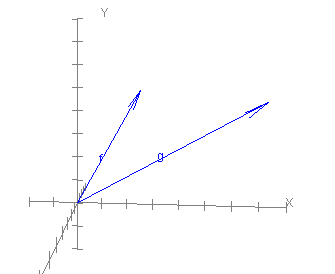
The figure shows two vectors, represented by:
f  =  (2, 4, 6)T

g  =  (6, 4, 3)T
Rotate the figure to get a better sense of the angle between the vectors.
You would like to measure this angle by laying a protractor flat across
the two vectors.
But you can't do this since all you see is the
projection of the two vectors onto the screen.


